

Dudjom Rinpoche (1904-1987)
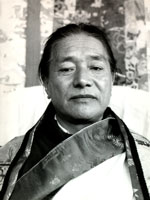
Kyabje Dudjom Rinpoche
Kyabje Dudjom Rinpoche was born in the year of the wood dragon. From his early childhood, Kyabje Dudjom Rinpoche astonished his peers by the ease with which he was able to master all aspects of Buddhist knowledge. He was renowned for his ability to express the most subtle nuances of Buddhist philosophy in accessible simple terms. He was the rallying point and guide of the Nyingmapa school in the first decades of exile from Tibet. His prolific written works include a history of Buddhism. In his last years, he spent much time teaching in France, the USA, the far East and Europe, finally establishing himself in France. Kyabje Dudjom Rinpoche passed away in the year of Fire hare at his residence in Dordogne, France.
The life story of Dudjom Rinpoche as told by himself
[from Counsels from my Heart, by Dudjom Rinpoche, translated by the Padmakara Translation Group]
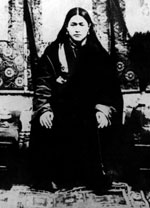
Dudjom Rinpoche in Tibet
I, Dudjom Jigdral Yeshe Dorje, was born in the year of the wooden dragon of the 15th rabjung cycle (1904). My birth place was the hidden land of Pemakö and my father was Jampel Norbu Wangyal of the royal line of Kanam. When I was only three years old, I was recognised by the disciples of the great tertön Dudjom Lingpa as the emanation of their master. They took me for their own, and thus I entered the door of Dharma.
“Reading and writing, are the roots of knowledge,” my teacher said and he made me study hard. At the same time, I had to memorise the rituals, prayers and so forth. I received instructions on the proper conduct of body, speech and mind. I also studied history, spiritual tales and the preliminary practices and, thanks to this, my intelligence developed a little. As the years went by, I was compassionately guided according to my ability by learned and accomplished lamas. I studied all the basic sciences such as grammar, spelling and poetry, astrology and medicine, as well as the Dharma texts and commentaries of Madhyamaka, Prajñaparamita, the Five Doctrines of Maitreya, the Bodhicharyavatara, the Three Vows and so forth. In particular, I revered the maturing and liberating tantras, their commentaries and the profound instructions of the oral and treasure teachings of the Nyingma tradition. —These ranged from the thirteen great activities of a vajra master to the rituals of the various practice traditions, making and decorating of tormas, dancing, drawing mandalas, chanting and music. Without overlooking anything, I trained most diligently in all the practical details of the vidyadhara lineage. Beginning with the accumulations and trainings of the preliminaries and up to the main practice, namely the approach and accomplishment sections of the generation stage, followed by the perfection stage practices, I persevered as much as I could, making up all the necessary numbers in the recitation.
However, I was led astray owing to the fact that I have the unfortunate title of lama. I became a slave to the distracting activities that are said to be for the benefit of the Doctrine and beings, and for that reason, I got about as much sign of accomplishment as feathers on a tortoise!
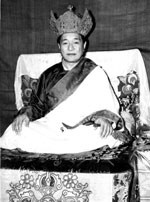
Kyabje Dudjom Rinpoche
Whatever nectar of Dharma I received, most of it I explained and propagated as much as I could to others, according to their nature. And though not deserving to be numbered among the learned, yet so as not to be a disappointment to those who requested me, and also in the hope that I might be of some service to the Teachings, I wrote and compiled more than twenty volumes. These contain for example: The History of the Nyingma School, A General Survey of Nyingma Teachings, a History of Tibet, a word for word commentary on the Three Vows, and instructions and guidelines for many cycles of practice. It is said that the result of receiving teaching is the ability to compose—so I wrote all these works without expectation and trepidation.
Thanks to the kindness of my great and holy teachers, the eyes of my pure perception were not blinded and I never accumulated the evil karma of abandoning the Dharma, of having wrong views and denigrating the teachings of others, or of criticizing anyone at all. And I am continually training myself in the wholesome attitude of avoiding all duplicity. But as I do not have the slightest doubt that I belong among the followers of the compassionate Buddha, albeit in the lowest ranks, I do occasionally have a slight feeling of pride. Which all goes to show that I can’t even tell the difference between right and wrong! This is a short life-story of myself, an old tantrika.

Biographies of Chanteloube's other founding teachers:
Breif biographies of the spiritual directors: