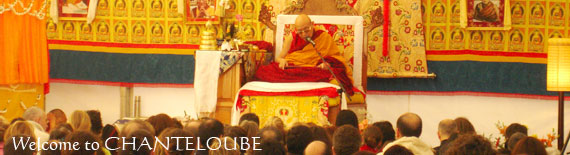


Dilgo Khyentse Rinpoche (1910-1991)
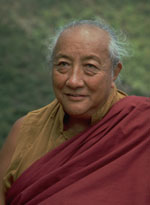
Kyabje Dilgo Khyentse Rinpoche
Kyabje Dilgo Khyentse Rinpoche was one of the last of the generation of great lamas who completed their education and training in Tibet. He was the senior lama of the ancient Nyingma tradition, the guru of the royal family of Bhutan, and an outstanding upholder of the Practice lineage, having spent twenty-two years of his life meditating in retreat and accomplishing the fruits of the many teachings he had received.
He also composed numerous poems, meditation texts, and commentaries—twenty-five volumes in all—and was a tertön, a discoverer of spiritual treasures, whose visionary revelations bring Padmasambhava’s profound oral pith instructions directly to us. Renowned for his ability to transmit the teachings of each Buddhist lineage according to its own tradition, he was the exemplary exponent of Tibet’s Rime, or nonsectarian, movement and the venerated teacher of many lamas of the four major Tibetan schools. He was also one of the leading masters of the pith instructions of Dzogchen, the Great Perfection, and one of the principal holders of the Longchen Nyingtik tradition. His Holiness the Dalai Lama has said that he regards Khyentse Rinpoche as his principal Dzogchen teacher.
Scholar, sage, and poet, Rinpoche never ceased to inspire all who encountered him through his extraordinary presence, simplicity, dignity, and humor.
Khyentse Rinpoche was born in 1910 in East Tibet’s Denkhok Valley. His family descended from the royal lineage of the ninth-century king Trisong Detsen; his father was a minister to the king of Derge. When still in his mother's womb, he was recognized as an extraordinary incarnation by the illustrious Mipham Rinpoche, who later named the infant Tashi Paljor and bestowed a special blessing and Mañjushri empowerment upon him.
Even as a little boy, Rinpoche manifested a strong desire to devote himself entirely to the religious life. But his father had other ideas. His two elder sons had already left home to pursue monastic careers; one had been recognized as an incarnate lama and the other wanted to become a doctor. Rinpoche's father hoped that his youngest son would follow in his own footsteps and manage the extensive family estates, and he could not accept that he might also be a tulku, or incarnate lama, as had been indicated by several learned masters.
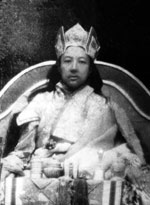
Kyabje Dilgo Khyentse Rinpoche, Tibet
At the age of ten, the boy was taken severely ill; he was bedridden for nearly a year. Knowledgeable lamas advised that unless he was allowed to embrace the spiritual life he would not live long. Yielding to everyone’s entreaties, his father agreed that the child could follow his own aspirations in order to fulfill his destiny. Thus it was that, aged eleven, he entered Shechen Monastery in Kham, East Tibet, one of the six principal monasteries of the Nyingma School. There, his root guru, Shechen Gyaltsap, Mipham Rinpoche’s Dharma heir, formally recognized and enthroned him as an incarnation of the wisdom-mind of the first Khyentse Rinpoche, Jamyang Khyentse Wangpo, the peerless lama who—along with the first Jamgön Kongtrul—set in motion a Buddhist renaissance throughout Tibet. All contemporary Tibetan masters draw inspiration and blessings from this movement.
Khyen-tse means wisdom and love. The Khyentse tulkus are incarnations of several key figures in the development of Tibetan Buddhism. These include Longchenpa, the brilliant fourteenth-century Dzogchen master whose prolific writings illuminate the entire range of Buddhist knowledge; Jigme Lingpa, who in the eighteenth century founded the Longchen Nyingtik tradition; and King Trisong Detsen and Vimalamitra who along with Guru Rinpoche brought tantric Buddhism to Tibet in the ninth century.
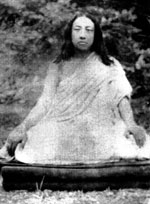
Dilgo Khyentse Rinpoche at the age of twenty
At Shechen, Khyentse Rinpoche spent much of his time studying and meditating with his root guru in a hermitage above the monastery. During this time Shechen Gyaltsap gave him all the essential empowerments and instructions of the Nyingma tradition. Rinpoche also studied with many other great masters, including the renowned Dzogchen Khenpo Shenga, who imparted to him his own major work, The Thirteen Great Commentaries. He received extensive teachings and transmissions from more than fifty teachers in all.
Before Shechen Gyaltsap passed away, Khyentse Rinpoche, then aged fifteen, promised his beloved master that he would unstintingly teach whoever asked him for Dharma. From then until he was twenty-eight, he spent most of his time meditating in silent retreat, living in isolated hermitages and caves or simply under the shelter of overhanging rocks in the mountainous countryside near his birthplace. His mastery of the mystic heat (tummo) practice was such that the inside of his cave was warm even during the icy Tibetan winters. He also left the imprint of his foot in a rock below one of his hermitages.
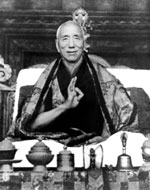
Jamyang Khyentse Chokyi Lodro
Dilgo Khyentse Rinpoche later spent many years with Dzongsar Khyentse Chökyi Lodrö (1896-1959), who was also an incarnation of the first Khyentse. After receiving from Chökyi Lodrö the many empowerments of the Rinchen Terdzö, the collection of Revealed Treasures (termas), Rinpoche told him he wished to spend the rest of his life in solitary meditation. But Khyentse Chökyi Lodrö’s answer was, “The time has come for you to teach and transmit to others the countless precious teachings you have received.” From then on, Rinpoche worked constantly for the benefit of beings with the tireless energy that is the hallmark of the Khyentse lineage.
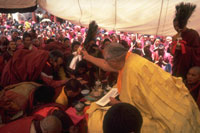
Dilgo Khyentse Rinpoche giving empowerments
During the 1970s and ’80s, despite his age, Khyentse Rinpoche travelled all over the Himalayas, India, Southeast Asia, and the West transmitting and explaining the teachings to his many disciples. He was often accompanied by his wife, Sangyum Lhamo, and his grandson and spiritual heir, Rabjam Rinpoche.
Wherever he was, he used to rise well before dawn, praying and meditating for several hours before embarking on an uninterrupted flow of activities until late into the night. He accomplished a tremendous workload with total serenity and apparent effortlessness.
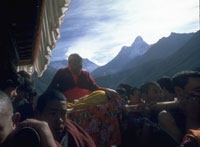
Dilgo Khyentse Rinpoche in Tibet
Rinpoche made three visits to Tibet between 1985 and 1990. There, he inaugurated the rebuilding of the original Shechen Monastery, destroyed during the Cultural Revolution, and oversaw the restoration of Samye Monastery, which he consecrated in 1990.
Dilgo Khyentse Rinpoche
giving empowerments
In Nepal, Khyentse Rinpoche transplanted the rich Shechen tradition to a new home—a magnificent monastery in front of the great stupa of Boudhanath. This became his principal seat, housing a large community of monks, led by their abbot Rabjam Rinpoche. It was Khyentse Rinpoche’s particular wish that this should be a place where the Buddhist teachings would be continued in their pristine purity, just as they were previously studied and practiced in Tibet, and he invested enormous care in the education of the promising young lamas capable of continuing the tradition.
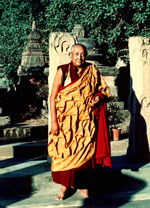
Dilgo Khyentse Rinpoche,
Bodhgaya, India
Other projects dear to him included the building of stupas and monasteries in sacred places, which he said would help promote world peace, further Buddhist values and practice, and help avert conflict, disease, and famine. In India, he built a new stupa at Bodhgaya, the site of Shakyamuni Buddha’s enlightenment beneath the Bodhi Tree. Preserving Tibet’s extraordinary heritage of Buddhist literature was particularly important to him. After the systematic destruction of books and libraries in Tibet by the Chinese, many works existed in only one or two copies. Thanks to Khyentse Rinpoche’s efforts, almost three hundred volumes of texts that might otherwise have been lost forever have been published.
Through his extensive enlightened activity, Khyentse Rinpoche unsparingly devoted his entire life to the preservation and dissemination of the Buddha Dharma. His greatest satisfaction was to see the Dharma actually practiced.
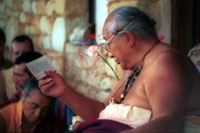
Dilgo Khyentse Rinpoche
at La Sonnerie, Dordogne France
He made a number of teaching visits to the West during the last fifteen years of his life, including two North American tours. At his European seat, Shechen Tennyi Dargyeling in Dordogne, France, (see Songtsen: location) where people from all over the world received extensive teaching from him, he guided several groups of students in traditional three-year retreats. It is a measure of his contribution to establishing Tibetan Buddhism in the West that no fewer than five hundred disciples from Europe and North America attended his cremation in Bhutan in 1992.
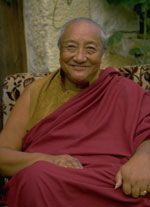
Dilgo Khyentse Rinpoche, Dordogne, France
No factual account of Dilgo Khyentse Rinpoche’s life can fully convey who he was. Those who had the immense fortune to spend any time with him knew they were in the presence of an authentic living Buddha, for he completely embodied the teachings he propagated and the great spiritual masters whose lineages he held. Even strangers were profoundly touched by his presence and instinctively sensed his exceptional humanity and spiritual qualities. His whole life was a true continuation of the lineage that had come down to him through the great masters of the past.
Kyabje Khyentse Rinpoche passed away in 1991, in the year of the iron sheep.
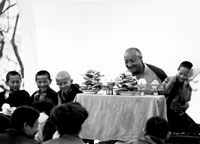
Dilgo Khyentse Rinpoche,
with young tulkus
* Photos provided courtesy of Matthieu Ricard.

Biographies of Chanteloube's other founding teachers:
Breif biographies of the spiritual directors: